همین حالا تماس بگیرید!
پاسخ فوری و مشاوره رایگان در انتظار شماست.
The hollow sound of a newly installed ceramic is not a problem that can be masked with a brace. If the adhesive is not transferred to the back of the part, the true cost of the project will show itself after installation: loosening, component failure, and destruction for repair.
The right tile and ceramic adhesive should be chosen according to the material of the piece, its dimensions, the work and the place of installation; Not just with the price per bag. This difference is more important for low absorption porcelain and large slab. Before buying, match the technical specifications of the product with the project conditions and check the adhesion and back cover of a piece before full implementation.
What are the characteristics of ceramic tile adhesive suitable for the project?
The appropriate adhesive should stick to both the part and the sub-work and create a sufficient coverage under the ceramic under the actual installation conditions. The brand name or the phrase "special for porcelain" alone does not take the place of checking the technical category, the level of work and the manufacturer's instructions.
To begin, answer four questions together: What are you installing, on what surface, in what space, and with what dimensions? The answers clarify the range of choices. Installing a regular tile on an interior wall is not the same as installing a porcelain slab on a wet floor or wall.
In the specification of cementitious adhesives, codes such as C1, C2, T, E and S1 help to choose. C2 refers to the category of cementitious adhesive with improved adhesion performance; T indicates resistance to sliding on vertical surface and E indicates longer open time. S1 also represents the deformability of the glue. However, even a suitable technical category is not a license to use the product on every subtask; Read the authorized use from the technical sheet of the same product.
The buying rule is: First determine the installation conditions, then compare between products that the manufacturer has explicitly introduced for the same application.
What is the difference between normal tile glue, porcelain glue and slab glue?
The main difference is not only in the name on the package; The type of part and the method of execution determine what performance the glue should have. The larger the piece and the more sensitive the work, the more important the surface preparation, adhesive transfer and technical order of the product.
What to check for ordinary ceramic tiles?
For ordinary tiles in dry interior, choose an adhesive that the manufacturer considers suitable for the material of the piece, the floor or wall and the existing sub-floor. Before buying in bulk, read the consumption amount and execution times from the technical sheet of the same product.
The term "tile adhesive" alone does not indicate that the product is suitable for plaster walls, cement floors or installation on old ceramics. If the surface is discolored, loose, greasy or uneven, changing the brand of glue will not solve the underlying problem. First, the surface should be prepared according to the instructions of the operating system.
What changes for porcelain and slabs?
For low absorption porcelain and slabs, choose a product whose use is approved for the dimensions of the piece and installation conditions in the technical sheet. In these projects, controlling the smoothness of the substrate and the real coating behind the part is as important as the choice of glue.
For example, a manufacturer's technical manual recommends C2TE S1 grade adhesives for some large installations; But for some more difficult conditions, it considers another product or category. So "any C2 glue is enough for every slab" is not a correct conclusion. If the back of the slab has a mesh or reinforcement coating, check the compatibility of the adhesive specifically with the same backing.
Project conditions | Priority in choosing glue | Important control before implementation |
Normal tile, interior space Dry | Confirmation of application for the material of the part, sub-work and floor or wall | Strength and cleanliness of the surface |
Low absorption porcelain | Explicit confirmation of application for porcelain and installation conditions | Glue transfer to the back of the piece |
Slab or large piece | Confirmation of dimensions and type of work on the sheet Technical | Smoothness of the substrate and cover under the part |
Wall or wet space | Compatibility of glue with the implementation system and vertical surface | Sealing Independent and edge support |
Installation on old ceramic | Confirmation of application on low absorption surface and necessary preparation | Consolidation of old coating and local testing |
This table is a guide to sifting through options, not a substitute for a product data sheet. For example, some ready-made paste adhesives for porcelain are only allowed in limited dimensions and on porous substrates; Installing the same product between the porcelain and the impermeable surface can be contrary to the manufacturer's instructions.
Five implementation errors that make even the right glue ineffective
If the substrate is not ready or the glue grooves do not sleep under the part, buying more expensive glue alone will not prevent failure. The best control is to see the back of the piece at the very beginning of the work and modify the execution method before continuing the project.
- Using glue to smooth the substrate: Correct the depression and protrusion with the appropriate method and materials before installation. For large parts, surface smoothness is especially important; The installation glue is not supposed to replace the leveling operation.
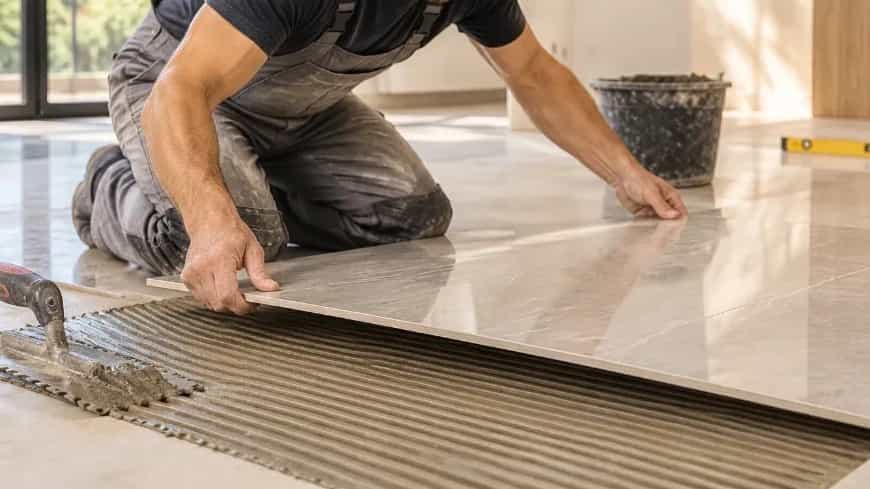
- Irregular or spot combing: Apply the glue on the substrate according to the product instructions and make the grooves in one direction. Move the piece perpendicular to the groove path so that the grooves sleep; A few clumps of glue in the corners and in the middle will not support the back of the part well.
- Assuming that the back of the part means full coverage: Lamination of the back of the part can help the bond, but the real coverage is formed when the glue has enough contact between the part and the substrate. Every few pieces, remove the newly installed piece and check the back.
- Installation on peel-off adhesive: Don't just rely on the time on the package; Heat, wind and the condition of the work can change the work time. Check the surface of the adhesive during application, and if the shell is closed, apply new adhesive according to the manufacturer's instructions.
- Knowledge of adhesion and sealing: Choosing the right adhesive for the bathroom does not replace the right sealing system. The substrate, the sealing layer and the adhesive must be compatible with each other.
In order to evaluate the coverage, the installation location should also be considered. The Tile Installation Training Foundation's guide states a minimum mortar coverage of 80% in dry indoor spaces and 95% in showers and outdoor spaces; The edges and corners of the piece should not be left without support. In the project, make the technical specifications and performance requirements related to the same system the final criteria.
How to decide to buy porcelain glue and slabs in Tehran?
Before asking for a price, prepare the part and sub-task information so that the seller can suggest compatible options. Comparing the price of each bag does not give a complete picture of the cost of the project without checking the amount of consumption, necessary preparation and possibility of rework.
Suppose you are going to implement the reception floor with large-sized porcelain. There is a lower price option, but it is not clear from the information you have that it applies to the dimensions of the piece; Another option has a specific technical sheet that explains its application and implementation method. A defensible decision is not to immediately buy the more expensive option; First verify the compatibility of both options and then compare the approximate consumption and total cost.
For a more accurate order, give this information to your salesperson or technical advisor:
- The material, dimensions and thickness of the piece and the presence of a net or cover behind it;
- Installation location: floor or wall, indoor or outdoor, dry or wet;
- Type of work: cement, plaster, old ceramic or other surface;
- Project area and smoothness and strength of the surface;
- Limited execution time and time required for exploitation.
If you are searching for the phrase "The best porcelain and slab adhesive sales center in Tehran", instead of relying on advertising titles, ask the seller for the technical sheet of the proposed product, confirmation of its use for your project, and consumption estimation. To check the suitable option for the project and to inquire about the purchase, you can share the same specifications with Mak Zafari Ceramic Tile Adhesive; Match the final choice with the technical information of the product being offered.
summary; Start the selection from the project conditions
To buy ceramic tile adhesive, first specify the piece, sub-work and installation location; Then compare the approved use of the products and take the implementation method seriously. In porcelain and slabs, the smoothness of the substrate and the coating on the back of the piece are as important as the characteristics of the adhesive. If you want to check the options for your project in more detail, send the dimensions of the piece, the photo of the work and the area of the work to Mak Zafari Ceramic Tile Adhesive and ask for the technical sheet of the proposed product before placing the order.
