همین حالا تماس بگیرید!
پاسخ فوری و مشاوره رایگان در انتظار شماست.
Two weeks have passed since the kitchen renovation. You step on one of the newly installed ceramics and the hollow sound beneath it takes away all satisfaction from the job. This problem is not always due to "poor quality glue"; Sometimes the glue was suitable, but it did not fit with the ceramic material, the work or the execution method.
To buy ceramic tile adhesive, first specify four things: type and size of tile, type of work, degree of contact with moisture and installation location. Then adapt the technical specifications of the glue to the same conditions. If you are shopping in Tehran, before placing the order, tell the seller the amount of consumption and the conditions of the project implementation; The name of the product alone is not enough to choose.
Which ceramic tile adhesive is suitable for your project?
The best adhesive is a product that has been approved by the manufacturer for the tile, subfloor and environment of your project. For example, choosing an interior drywall adhesive is not the same as choosing a large porcelain ceramic adhesive on a floor or balcony.
Perslani ceramic has little water absorption and its implementation, especially in large dimensions, is sensitive to the choice of adhesive and suitable coating on the back of the piece. In contrast, for small tile on a healthy cement sub-floor in a dry environment, you may need a product with different characteristics. Before comparing brands, read the application listed on the package and the technical sheet of each product.
If you see codes like C1, C2, T, E or S1 on the package, don't mistake them for "good" or "bad". In the technical classification, C refers to cement-based adhesive; 1 shows normal performance and 2 shows improved performance. T indicates reduced vertical slip, E longer open time, and S1 adhesive deformability. The existence of any code does not take the place of checking the compatibility of the product with the entire installation system.
The difference between powder and paste glue; Compare to buy
Powder and paste glue should not be chosen solely based on the convenience of use or the package price. The installation location, the amount of absorption of the substrate and tiles, the dimensions of the piece and the manufacturer's recommendation determine which option is suitable.
When to check powder glue?
Powder adhesive, if approved by the manufacturer, is an option for a wide variety of floor and wall installations. For porcelain, large pieces, outdoor space, or installation over old coating, you should go for a formula whose data sheet allows for the same application.
Mix this glue with the amount of water specified in the product recipe. More water may make the mortar easier to spread, but it changes the mixing ratio; Therefore, do not adjust the consistency of the glue by guesswork and experience of another product. The time of use of mixed mortar is also specific to the same product.
When should we check the paste glue?
The paste adhesive is ready to use, but "ready" does not mean "suitable for every surface". Before buying, read its limits for humidity, tile dimensions and low-absorption underlay from the technical sheet.
Some paste adhesives need an absorbent substrate to dry. For this reason, you should not choose them for installation on a sealing membrane or between two low-absorbent surfaces based solely on their ready-to-use properties. If your project is tile-on-tile or a large porcelain installation, check the compatibility of the product with this combination specifically.
Project status | Options to check | Determining point before buying |
Small zinc tile Healthy cement subfloor in a dry environment | Approved adhesive for tiles and the desired subfloor | Type of wall or floor, subfloor conditions and size limitations |
Porcelain or large ceramic | Powder adhesive suitable for porcelain and piece dimensions | Dimension limit, execution method and ceramic back cover |
Installing a new tile on an old tile | A product that is installed on Explicitly allows low absorbent surface | Firmness of old tiles, cleaning and surface preparation |
Bathroom and permanently wet area | Adhesive compatible with wet environment and system Sealing | Perform independent sealing; Adhesive alone will not replace it |
Balcony or surface subject to temperature changes | Product approved for exterior use | Weather conditions, seams and instructions Product |
Purchasing note: This table is not a prescription version of the product; It shortens the comparison path. Check the exact name of the product, technical class and its limitations on the package and technical sheet of the same product.
What should we check before the implementation so that the tile does not loosen?
Appropriate adhesive does not perform well on loose, greasy, or contaminated subfloors. An important part of installation quality is determined before opening the adhesive package and during surface preparation.
This simple arrangement reduces the possibility of rework:
- Check the strength of the subwork. Repair any peeling, loose or cracked parts before installation. If you are working on an old tile, first make sure of the adhesion of the previous tiles; Fresh tile does not secure the loose sub-layer.
- Clean and prepare the surface. Dust, grease, wax and dirt prevent the adhesive from properly contacting the sub-floor. For special sub-tasks, get the required preparation method and primer from the product manufacturer's instructions.
- Prepare the glue according to the instructions of the same product. Read the water ratio, mixture resting time, and permitted usage time from the package; These numbers are not the same between products.
- Do not glue a surface more than your installation capacity. Heat, wind and absorbent underwork can shorten the time of adhesive removal. If a surface dry layer forms on the adhesive, do not press the tile on it without checking.
- Check the coating on the back of the tile. After installing several pieces, lift one and see the contact of the adhesive with its back. In large parts and some external or wet applications, adhesive behind the part is also necessary to achieve proper coverage.
Another costly mistake is to confuse adhesion with sealing. In the bathroom and shower, tiles and grout alone do not make a waterproof system; Before installing the tile, you should consider the appropriate sealing for the place of implementation.
A practical guide to buying tile and ceramic glue in Tehran
For an accurate purchase, prepare project specifications instead of a general request for "a strong glue". This information will help the seller eliminate unsuitable options and realistically estimate the order quantity.
Suppose you want to cover 18 square meters of kitchen floor with porcelain ceramic on top of strong old tiles. When inquiring with Mak Zafari Tile and Ceramic Adhesive or any other seller, state these four things: ceramic dimensions, material and condition of the old floor, work area and installation location. Then ask which product explicitly allows the installation of porcelain on the existing tile and what preparation is required.
Use the following formula to estimate the value:
For example, if the chosen product with the trowel and the method of execution of your project consumes about 5 kg per square meter, 18 square meters will require approximately 90 kg of glue. Assuming 10% executive reserve, the estimate reaches 99 kg; That is, for hypothetical packages of 25 kilos, four packages. This number is not the specification of any Makzafari product and should be modified after seeing the package weight and actual consumption of the selected product. The consumption of glue changes with the size of the trowel's comb, the condition of the surface and the dimensions of the tile.
Before finalizing the order in Tehran, ask these questions:
- Is the product approved for my type of tile, subwork and installation location?
- What is the recommended consumption with the dimensions of the desired tile and trowel?
- What is the package weight, production date and storage conditions of the product?
- Do I need preparation or complementary product for this subwork?
- Inventory, shipping cost and What is the delivery time to the project site?
summary; What should we decide before buying?
First determine the installation conditions, then choose the tile and ceramic adhesive. The material and dimensions of the tile, the strength of the work, the humidity of the environment and the amount of consumption are the four bases of your decision.
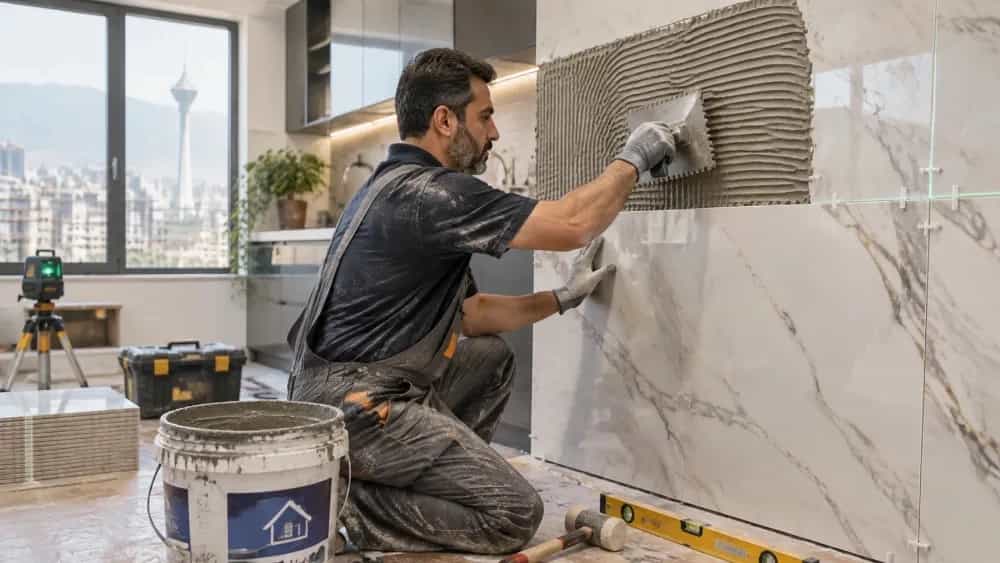
If you are in doubt among several options for purchasing in Tehran, prepare the project specifications and the following image and ask Makzafari tile and ceramic adhesive for advice on the suitable product, preparation method, and number of required packages. A few minutes of checking before buying will prevent inappropriate product selection and rework costs.
