The wholesale purchase of porcelain and slab adhesive in Vanak, Tehran refers to the supply of powder and paste adhesives with a special grade for low absorption surfaces, large dimensions and wall installation, which is usually done through suppliers located in the area of Vanak and the streets leading to it. The main difference between this market and retail shopping is in order volume, stability of technical specifications between production batches and delivery time commitment. Makzafari tile and ceramic adhesive has focused on this point: major supply for contractors who cannot accept the risk of quality change between two stages of a project.
Coordinates of Vanak Tehran market for bulk purchase of porcelain glue and slabs
Vanak has long been one of the supply nodes for building materials in the north of the center of Tehran. The concentration of contracting offices, renovation projects and reconstruction of residential and office units in this area has created a centralized buying market where the seller must have both a real warehouse and continuous supply. According to our technical reviews in the Venk and Mirdamad area renovation projects, the most major requests fall into two categories: floor restoration projects with porcelain ceramic larger than 60 x 60 and projects that implement wall slabs and low-thickness floors on old surfaces.
In practice, it has been observed that the major buyer in this area measures three criteria at the same time: the price per kilogram or bag, the delivery time to the workshop, and the stability of adhesion in the environmental conditions of old buildings. This is the third criterion that creates the biggest difference between suppliers and is not seen in the announced prices.
porcelain glue and slab glue; Technical difference that affects the price
A common mistake in bulk buying is to see porcelain glue and slab glue as the same. Porcelain tile is produced with low water absorption, and its glue should have higher wetting and adhesion power than ordinary ceramic glue. The slab, however, has greater weight and dimensions, and the resulting dead load requires an adhesive with controlled deformation and a longer open time. In major projects, the difference between the two shows itself in the actual consumption of each square meter, not in the price of each bag.
Characteristics | Porcelain adhesive | Slab adhesive |
Target surface type | Low absorption porcelain tile | Heavy and large slabs |
Primary adhesive strength | High | High with a focus on sustainability |
Conformability | Medium | High |
opening time | standard | longer |
suitable for wall implementation | Yes | Yes with mechanical support |
Approximate consumption per square meter | About 4 to 6 kg | About 6 to 9 kg |
The main risk of execution | Edge separation | Sliding and falling of the screen |
Sensitivity to layer thickness | High | High |
Suitable for mass project | Yes | Yes with executive programming |
The consumption figures in the table above are workshop estimates based on the manufacturer's technical manuals and change depending on the smoothness of the work, the dimensions of the tiles and the execution method.
The challenge of providing raw materials and its effect on bulk purchases in the local market
A point that is less often seen in sales lists is the pressure of supply of raw materials on quality stability. Porcelain and slab adhesive depends on powder resins, polymer additives and mineral fillers, and fluctuations in the supply of these materials can change the final composition of the product between production batches. In bulk purchasing, this issue is more serious, because a contractor may order several stages in a project and expect the behavior of the adhesive to remain the same at each stage.
According to our technical investigations in industrial and workshop projects, three practical consequences of this situation can be seen. First, increasing the importance of sampling before mass ordering. Second, the willingness of buyers to source from a fixed source instead of purchasing broadcasts from multiple vendors. Third, emphasizing the role of the technical support of the seller to determine the thickness of the layer, the appropriate toothed tool and the implementation schedule.
A practical guide to bulk purchasing and supplier selection criteria
In bulk purchases, ask the supplier three questions before negotiating the price. First, whether the technical specifications announced on the package are consistent with the internal test or not. Second, if you need to order a supplement within two weeks, the same formulation can be provided or not. Thirdly, how will the technical support respond in the event of an executive issue.
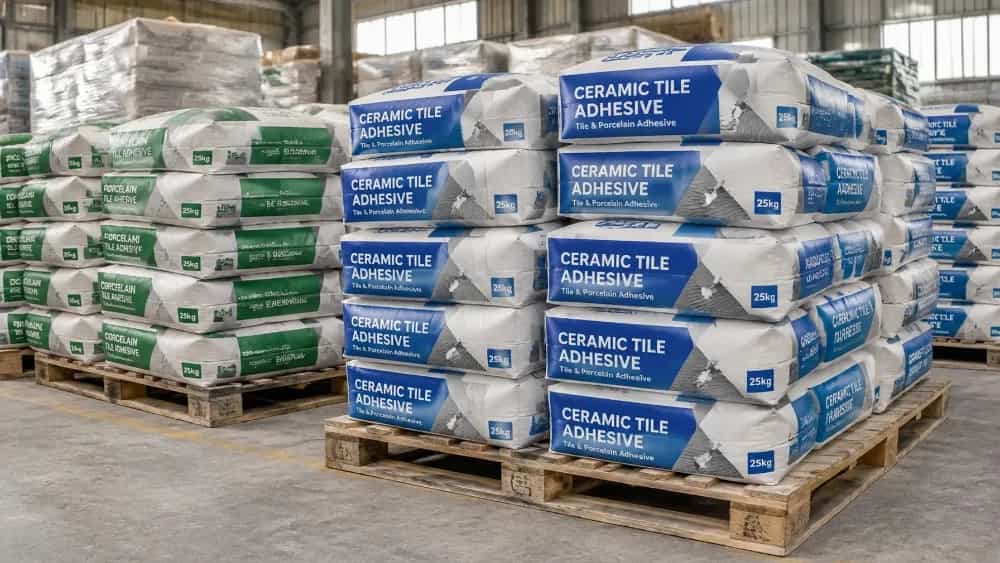
For stable supply, include these items in the main contract: the precise determination of the grade of glue suitable for the type of slab or porcelain, the agreement on the time frame of delivery to the workshop, the determination of how to pack and palletize according to the conditions of the warehouse of the workshop and specifying the volume of the supplementary order. Makzafari ceramic and tile adhesive, focusing on bulk supply and controlling the uniformity of production batches, implements this framework in the project transactions of Vanak Tehran.